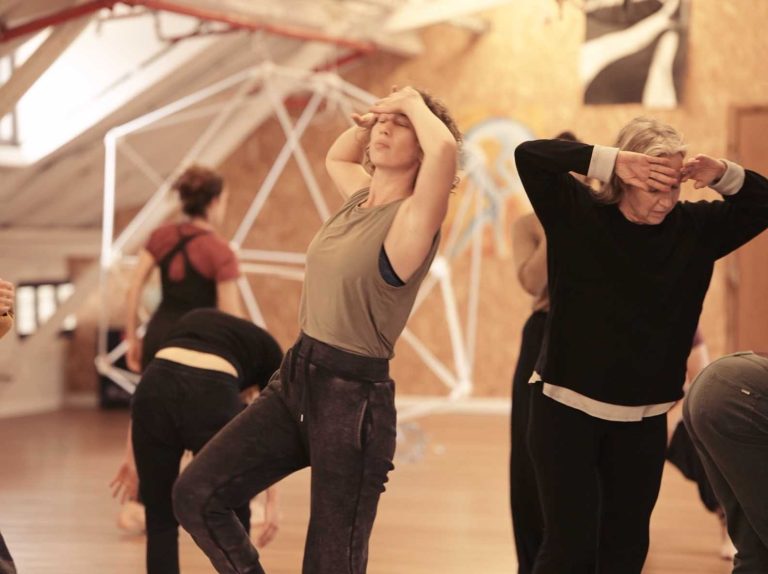
Still Photography: Yonathan Yacobi
Website Design & Development: Tal Bushari
'Laban Bartenieff' system invite you to enter a realm where artistry, science, and self-awareness converge in one system.
Unlock the boundless potential of the human body and explore the profound connection between movement and self-discovery.
Embark on a transformative journey that transcends the boundaries of conventional movement education.
Join us to learn a language that puts words and meaning to feelings and intuition. Come learn new ways to understand the human movement of people and perfect your own movement abilities while getting to know your personal movement signature.
'Laban Bartenieff' studies are a pathway to personal growth, professional development, and a deeper understanding of the body-mind connection.
Whether you are a caregiver, physical therapist, professional dancer, coacher, movement researcher, and more, these studies will take you one step further in your professional and personal world.
You may already sense that movement holds far more than what meets the eye.
Perhaps for you too, every encounter with body and movement carries a feeling of home, connection, and meaning.
This shows up in therapy, in working with people, in teaching, and in creative processes.
There is intuition, there is experience, and yet, something still feels incomplete.
This is an invitation to return to the source. To return to movement, this time with a precise, rich, and inspiring set of tools.
To learn the alphabet of movement, the ground from which it emerges, and to deepen into your own essence.
In this training, we invite you to join a journey of meaning, depth, and connection.
LBMS (Laban Bartenieff Movement System) is a system for movement assessment and for intervention. It is a comprehensive system used in exploring, understanding, identifying and interpreting multiple aspects of human movement patterns.
As a movement analysis system, LBMS is unique in the way it recognizes and codes all aspects of movement, which means both functional (ordinary) and expressive aspects of human movement.
Due to the system, it is possible to identify and differentiate between universal patterns common to all humans, group patterns (for example cultural), and patterns of a unique person.
The LBMS method will ask in every action: what, where, how and why.
“Movement in itself is the language in which our highest and most fundamentalinspirations are expressed”
(Rudulf Laban)
A movement-based introductory workshop with Karen Studd,
senior faculty member and pedagogical coordinator of the program
Friday, February 20, 2026, 10:00–13:00
Pantarhei Center, Kibbutz Ginegar
When we observe a person moving or when we move, our experience of the movement passes through the body. We understand something intuitively but it is difficult for us to say why and how. LBMS is unique in its comprehensive perspective of the phenomenon of human movement itself as our primary system and the basis for understanding mankind.
Our perceptions and the experience of our moving body are the basis of all the systems we as humans create. The word ’embodiment' is very accurate in describing a process in which everything we do passes through the body. In the LBMS system, everything is embodied within the body: our perception, experience and knowledge
Physiotherapists, occupational therapists, and practitioners from various therapeutic disciplines who wish to integrate a deeper and more holistic understanding of human movement into their therapeutic work
Emotional and somatic therapists from diverse fields who recognize the importance of movement within processes of change, development, and transformation
Movement researchers in academia, robotics programmers, and others involved in scholarly research and professional development related to human movement
Dancers, choreographers, movement creators, actors, and theatre practitioners interested in deepening their embodied understanding of movement as a foundation for creative work
Teachers and facilitators from a wide range of movement-based practices — such as Pilates, yoga, strength training, and related fields
Anyone who is fascinated by the world of movement and wishes to undergo a significant process as well as influence people in the future
"Breathe and be ready to change, change is here to stay!"
(Irmgrad Bartenieff)
The LBMS consists of sharing and developing the philosophy, theory and practice of Rudolf Laban and Irmgard Brantieff. Laban's work clarified human movement patterns by asking 'what is movement' Laban examined human movement in space, the energy of movement, its motivation and the mover's attitude into movement.
The combination of Laban's perception of space (Space Harmony) and the dynamics of movement (Effort) along with Bartenieff's work in clarifying the body's fundamentals and its development patterns all combined together into a rich and developed system of movement.
The full program comprises 500 academic hours, meeting the professional standards of ISMETA (the International Somatic Movement Education and Therapy Association).
The program is structured into four modules, all held at the studio: three divided into two eight-day sessions, and one extended twelve-day module.
You can register for the first module without committing to the next ones. In each module there are presentations that the participant is obliged to attend and enrich their knowledge and abilities.
The studies are delivered in several ways – theoretical, experiential and practical.
Throughout the four modules, the students will develop a deeper understanding of the self, the other and the community thanks to the process of perceptual awareness, analytical diagnoses, changing patterns and intervention.
Those who complete all the requirements of the program will receive certification as an LBMA -Laban Bartenieff Movement Analyst on behalf of the Whole Movement organization. The certificate is recognized by the ISMETA organization which allows its members to become somatic therapists and educators.
Two-Year Training Program | September 2026 – September 2028
Studies are held in the moving space of Pantarhei Studio, Kibbutz Geneigar.
Regular Studio Hours:
Sunday – Thursday: 9:00 AM – 6:00 PM
Friday: 8:30 AM – 3:00 PM
(No classes will be held on Saturdays, except during Pulse 1 weekend schedules)
Program Structure & Pulse Dates:
Please Note: The first pulse is a one-time exception with distinct dates and hours, structured across three weekend intensive sessions (Thursdays through Saturdays). All subsequent pulses (2 to 7) are held in consecutive daily blocks following regular studio hours.
Year I: Pulses 1–4
Pulse 1 (Conducted in Hebrew) – 8 days divided into 3 weekend intensives:
November 5–7, 2026 (Thursday starting from the afternoon)
December 10–12, 2026 (Thursday starting from the morning)
January 21–23, 2027 (Thursday starting from the afternoon)
Pulse 2: February 7–15, 2027 (8 consecutive days)
Pulse 3: July 1–15, 2027 (12 consecutive days)
Pulse 4: September 12–20, 2027 (8 consecutive days)
Year II: Pulses 5–7
Pulse 5: February 20–28, 2028 (8 consecutive days)
Pulse 6: July 2–7, 2028 (6 consecutive days)
Pulse 7: September 3–8, 2028 (6 consecutive days)
Early Registration – until May 15, 2026
₪1,154 per month for 26 months
(Total: ₪30,000)
Late Registration – from May 16, 2026
₪1,230.70 per month for 26 months
(Total: ₪32,000)
Single Module Registration
₪8,200 (total)
* Upon completion of all four modules, participants are required to submit a Final Project.
Supervision and submission of the Final Project involve an additional fee of $500, paid directly to the individual project supervisor.
Completion of the Final Project brings the total training hours to 500 hours, as required for recognition by ISMETA.
Cancellation Policy
Until April 30, 2026: registration may be cancelled subject to an ₪80 administrative fee.
Until May 30, 2026: registration may be cancelled subject to a ₪500 cancellation fee.
Until June 16, 2026: registration may be cancelled subject to a ₪4,100 cancellation fee.
After June 16, 2026, no refunds will be issued.
However, the paid amount may be credited toward the next training cycle, subject to the program terms and the Pantarhei website regulations.
In order to register for the program, you must fill out the following registration form that includes a personal essay. The next step would be to fill in details for the standing order.
Food – participants are responsible for bringing their own food. The studio has a fully equipped kitchen that allows cooking as well as heating food.
In addition, there are paid lunches in the dining room of Kibbutz Geniger at a cost of between NIS 25-35 per meal.
Accommodation – it is possible to stay overnight at the studio for those interested. Accommodation will be in the main hall on mattresses and in the clinic room at no extra charge.
In addtion Kibbutz Mizra has a guest house where you can get a 12 percent discount per night. In the near by area, there are a variety of guest houses and B&Bs and options for subletting. participants are responsible for finding a place for themselves.
Transportation – Geniger can be reached by bus that stops at the entrance to the kibbutz – a 7-minute walk from the studio. You can also get to the Kfar Baruch train station and we can arrange a ride for you (a 5-minute drive to the the studio).
A movement-based introductory workshop with Karen Studd,
senior faculty member and pedagogical coordinator of the program
Friday, February 20, 2026, 10:00–13:00
Pantarhei Center, Kibbutz Ginegar
Enhancing the movement, understanding the movement and its changes. from an in-depth perspective
Decision making, interaction and attentive listening to the sharpening intuition
"hands on" work
Finding what is essential in the complete picture of the movement within a context - and how the parts are related to each other
The LBMS training program provides participants with a broad range of movement analysis skills.
A central understanding that develops throughout the program is the essential relationship between decision-making, choice, and the creation of meaning.
Through the training, participants are introduced to the language of movement and begin to identify their personal movement patterns, as well as their conscious and unconscious choices. As these choices become more visible and embodied, processes of meaning-making, recognition, and transformation can emerge.
The curriculum is rich and multifaceted. Below is a brief overview of some of the key topics that accompany the learning process:
Irmgard Bartenieff outlined fundamental principles that help us support and understand human movement, as well as improve its efficiency and enhance our expression in the world.
Among these principles are Breath Support, Core Support, Spatial Intention, Movement Initiation and Sequencing, Rotational Support, and others.
Bartenieff’s work expanded and deepened the understanding of human movement through exercises that enable progression through space, changes in levels, and more efficient and supportive movement.
Through the Laban–Bartenieff approach, we learn to observe and intervene in order to help movement become more effective and beneficial, and in this way our capacity for expression also expands and grows.
Laban identified central themes that exist within our moving body, through which it is possible to explore both the physical movement of the body and our way of functioning in the world. These themes are based on a dual principle, according to which there is a whole that contains different parts that complement one another and function as opposites that depend on each other in order to exist.
Some of the central themes include: Mobility–Stability, Function–Expression, Inner–Outer, Self–Other, Exertion–Recuperation, Part–Whole, and others.
As human beings, we experience reality through patterns and structures. We easily recognize them and tend to move and act from within them. Through the Laban–Bartenieff approach, we learn to identify movement, cognitive, and emotional patterns through the understanding of movement.
We engage with early developmental movement patterns and become familiar with different bodily organizations. We identify ways of moving in space, among other aspects — all in order to expand the range of movement and enable further change within these patterns.
Laban and his students identified movement motivation — the how of movement. The quality that differentiates the way one person lifts an arm from the way another person lifts the same arm, or how the same movement appears in a different situation. They called this Effort, describing the inner life of movement — its dynamics.
Through understanding movement dynamics, they were able to identify tendencies and to describe why one way of moving may be more efficient than another. Within the LBMS system, understanding the dynamics of movement reveals much about our expressivity as human beings, whether we are aware of it or not.
Laban was interested in the moving body in space. Movement is change in space, and as such it occurs within space and defines it, just as space defines movement. Laban coined the term kinesphere to describe the sphere that surrounds our body. He sought for us to have access to all areas of our kinesphere, in order to expand our capacity for expression in the world.
To this end, he mapped the kinesphere using geometric forms that represent it, and within these forms created movement sequences that follow organizing patterns and structures. The work of Space Harmony constitutes a significant and essential part of the program and is highly distinctive within the field of movement research.
When a body moves in space, an interaction is created with the space in which it moves and with what surrounds it. In this way, encounters are formed and the body reaches out into its environment. Within the method, we address the question of how our shape enables us, in a unique way (and in a manner different from other beings), to relate, to connect, and to change our shape in response to others and in relation to the functional movement capacity of our shape.
In other words, we learn about the relationship between movement and relationships.
Within the Laban–Bartenieff work, we use touch in order to sense and understand movement, as well as to intervene and add information to the body. Through this process, new patterns and structures are able to surface and re-emerge in the world.
Human movement, like everything we do, exists within a phrase. We can observe a phrase as something vast and expansive — such as the entirety of our lives from beginning to end — and we can also observe the simple act of reaching an arm and returning it as a single phrase. Where do I place a period? Where a comma? An exclamation mark? These are actions we perform constantly, through which we give meaning to everything we do and how we move in the world.
Phrasing — the way we connect and separate different parts — inevitably creates a different meaning each time. Therefore, the more we become aware of our tendencies, the different syntactic possibilities, and the choices we make, the more we are able to create meaning and choose what is most appropriate for us.
Karen A. Studd, has a Master’s degree in Dance from University of Oregon and is certified in movement analysis through the Laban/Bartenieff Institute of Movement Studies (LIMS). Studd is also a Master Somatic Movement Educator and Registered Somatic Movement Therapist through ISMETA (International Somatic Movement Education and Therapy Association). She is a founding member of WholeMovement, a group of movement analysts working to increase the visibility of the Laban/Bartenieff Movement System (LBMS) worldwide.
She serves as a Program Coordinator and core faculty member in multiple movement analysis training programs internationally. She has taught LBMS in the US, Canada, Europe, Mexico, Israel and China. In the USA she has taught for the University of Oregon, the University of Wisconsin, George Washington University, The University of Maryland and George Mason University in its School of Dance, where she was a tenured faculty for over twenty years.
As a teacher of LBMS, she is focused on both personal and professional development through movement awareness training. Her primary interest is in promoting the understanding of the significance and importance of human movement across all disciplines. Studd is also an author who has contributed to multiple research papers focused on human movement linked to the LBMS. She is a co-author of EveryBody is a Body, a text on the phenomenon of human movement now in its second edition. She also writes blog posts for the WholeMovement website which can be found at: https://wholemovement.org/blog/
Esther Geiger is a movement teacher and observer/analyst. She is a Certified Movement Analyst (CMA) through the Laban/Bartenieff Institute of Movement Studies (LIMS). She is also a Registered Somatic Movement Educator (RSME) through ISMETA (International SomaticMovement Education and Therapy Association).. Esther is a member of WholeMovement, agroup of movement analysts working to increase the visibility of the Laban/Bartenieff Movement
System (LBMS) worldwide.
She has taught in LBMS certification programs in Maryland, New York and Tel Aviv. She is also the coordinator of the Washington Area Certified MovementAnalysts (WACMA), a c continuing education and networking resource for CMAs in the
DC/MD/VA region.
Esther holds a BA in Early Childhood Development from Antioch University and an MA in Liberal Studies, with a major in Movement, from Wesleyan University. She toured for ten years with dance and theatre companies doing in-school performances; worked as a pre-school teacher;
served as a yoga center administrator; and has choreographed and taught using Richard Bull’s Structured Improvisation techniques. Esther has practiced Iyengar Yoga since 1980.
She is currently a Partnering Artist with the Dance Exchange, based in the Washington DC area; and serves as a movement description consultant with Audio Description Associates. She has published articles on audio description for dance, including “Listening to Movement”, co-authored with Joel Snyder, PhD.
Esther’s focus is on finding intersections between these various fields, with Movement Studies as the thread through. She has thus applied her movement training to yoga practice and instruction, playground design, personnel administration, unschooling, and audio description, among other endeavors.
CMA, RSMT, is senior teacher of the Laban/Bartenieff Movement System, recognized by ISMETA as a Master Somatic Movement Educator and Therapist, as well as a teacher of the Alexander Technique. She has coordinated LIMS ISMETA trainings and authored Laban/Bartenieff-based Somatic Movement Therapy, methodology and case studies.
In Israel, Tsachor founded the Certification Program in Laban Movement Studies, and has been a guest teacher at Kibbutzim College, Wingate College, The University of Haifa and the Technion.
She is also certified with the Center for Mind-Body Medicine and has taught Mind-
Body Skills for Global Trauma Relief at the Israeli Center for Integrative Group Counseling,
sharing her clinical experience with these evidenced-based practices.
Rachelle Palnick Tsachor uses the art of movement to inform scientific research. She is co-
author with Dr. Tal Shafir of Emotion Regulation Through Movement (Frontiers in Psychology) and A Somatic Movement Approach to Fostering Emotional Resiliency (Frontiers in Neuroscience), along with numerous studies in movement therapy.
How Do We Recognize Emotion From Movement explores ways that perception of emotions from movement relates to empathy, all of which interacts deeply with Somatic Movement practices, as discussed on the podcast Somatic Radio. Their research was recently the basis of “The Joy Workout—Exercises for Happiness” featured in the New York Times, and is also the basis of studies affective computing and intelligent interaction applying movement to such fields as robotics and machine learning.
Milca Leon MADS, CMA – an experienced movement educator and Somatic Therapist specializing in Laban/Bartenieff Movement Studies. She has received her M.A from The Laban Centre in London, in Laban Movement Analysis, Choreography and Education in Dance and she is a Refistered Somatic Therapist (RSMT) from ISNETA.
She taught at The Laban Centre, CSSD and other Acting Colleges in London for 4 years. Upon returning to Israel, her homeland, she taught at the Dance Academy in Jerusalem and Bat-Dor dance School for 9 years. She now teaches Laban-based work and movement analysis at The University of Haifa’s Creative Arts Therapy graduate program and at Haifa's High school for the Arts. She has studied Adler-based group facilitation and is a personal coacher. Leon’s published articles in books and professional magazines in the fields of Dance Education and Movement Analysis, in Israel and the UK, and she wrote parts of the National Curriculum in Dance for the Ministry of Education in Israel.
Leon teaches independent Laban-Bartenieff based movement courses for therapists, educators, coaches, dance and acting teachers, dancers, and actors.
In these courses she combines knowledge and experience based at LBMS, BMC, Yoga, Pilates, acting and group facilitation.
Avital is a Movement Therapist (DMT) and certified in Movement Analysis (CMA) by the Institute for the Laban Bartenieff system for Movement Investigation (LIMS). Avital is recognized as a Somatic Therapist (RSMT) by the ISMETA organization
Avital is a graduate of the three-year program at Dania Elraz's 'Group for Contact Improvisation'. Practicing and teaching contact improvisation for 16 years and has studied with many teachers in Israel and abroad. Avital owns and manages the 'Pantarhei' studio and the 'Nana – movement from within' school for dance and somatic movement.
These days Avital is in the certification process of the Somatic Experiencing program. She has a Thai massage therapist certificate as well as a Pilates teaching certificate. Has Created and taught in Boston, Utah and Europe at several festivals.
“ I believe that exploring movement is infinite. In 'somatic work' we approach the body with the desire to bring the physical experience closer to an understanding of the movement of the body and its structure. One affects the other and vice versa. When we bring the two closer, the connection between the body and the mind is revealed. By becoming familiar with our movement patterns and learning patterns we have already forgotten, we can create a significant change in our lives.”
A movement-based introductory workshop with Karen Studd,
senior faculty member and pedagogical coordinator of the program
Friday, February 20, 2026, 10:00–13:00
Pantarhei Center, Kibbutz Ginegar
Movement is the foundation of us all. It is the most universal language we have, and the one that connects us. Every choice we make in movement, whether conscious or unconscious, functional or expressive – carries meaning.
As human beings, we are constantly seeking meaning. We recognize patterns and structures, and we live and act through them.
When we learn to observe movement, understand it, and choose it consciously, we begin to uncover its deeper meaning and our own.
“A voice called, and I went.
I went, because the voice called.”
Hannah Senesh
The call to move is stronger than we are.
Those of us for whom movement is an essential part of our being — and of how we communicate with the world — are called to listen, to follow, and to allow this call to lead us forward toward fulfilling our purpose.
We invite you to join a community that chooses to listen to the call.
Still Photography: Yonathan Yacobi
Website Design & Development: Tal Bushari